



Recently, cars powered by alternative energy sources have become more and more popular. Car manufacturers promise light, fast, economical to maintain and very ecological vehicles. However, are these promises justified?
Let's review the facts together.
Each of us has once dreamed of having a car that is not only ecological, but also does not require charging or even fuel. This sounds like a scenario straight from the future, right? But is it really possible? Do such cars exist now? Can they meet our expectations?
These are questions worth answering before purchasing an alternative vehicle.
Pursuing excellence: A new ecological challenge
Reality presents us with challenges that we must meet. We are facing a climate wall that requires us to be more involved in environmental protection. This is not just a temporary trend, it is a challenge that affects each of us. Although we are taking more and more actions to improve the situation, we still have a lot of work ahead of us.
Constructors and manufacturers of electric cars are perfectly aware that the future of the automotive industry lies in zero-emission vehicles. They are constantly developing modern concepts to create a car that is not only ecological, but also does not require electric charging. This process is to be supported by renewable energy sources.
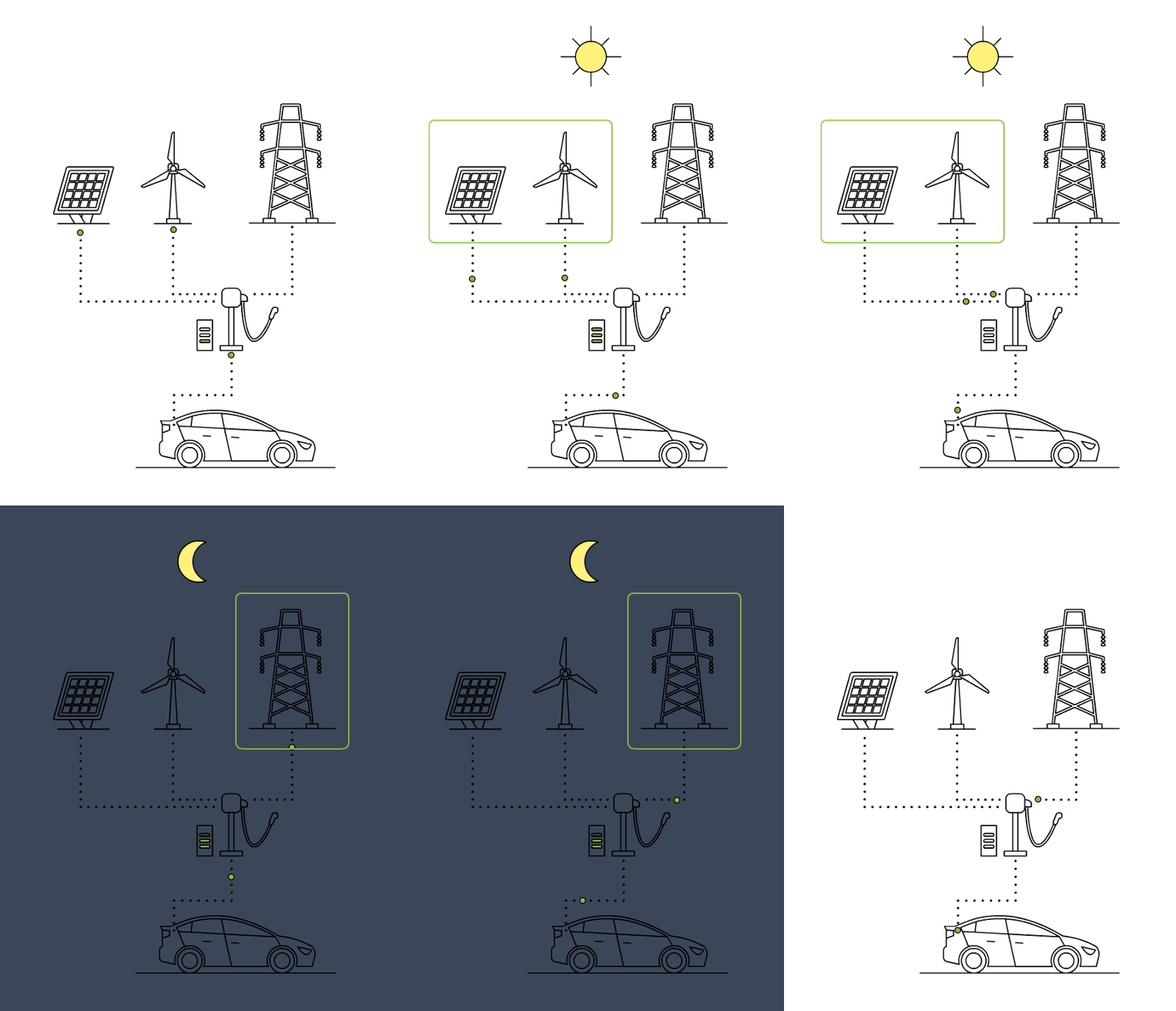
The first models of solar-powered vehicles have already been created, but their popularity on the market remains low. Despite the initial enthusiasm, many people still do not decide to buy them.
Why is this happening?
The concept of a car powered by 100% solar energy is not new. Since the 1950s, attempts have been made to create a vehicle that would use a "natural" drive. Unfortunately, we have not yet achieved this ideal. Nevertheless, we are getting closer to its implementation.
The photovoltaic revolution in the automotive world
Photovoltaics is becoming more and more popular and is becoming an integral element of many areas of life. Currently, it can be found on the roofs of houses, in electric vehicle charging stations, and even on car bodies.
The German Fraunhofer Institute ushered in a new era by presenting a photovoltaic car hood, where solar cells were mounted on a metal mesh instead of traditional foil or glass.
However, the real breakthrough was Lightyear One, a product of a Danish company. This car not only impresses with its design, but also with the scale of application of photovoltaics. Lightyear One is almost self-sufficient, equipped with a standard battery that can be charged with electricity, but also with solar panels placed on the hood, roof and rear of the car, covering a total area of 5 m². Thanks to them, on a sunny day, the car can produce enough energy for an additional range of up to 96 km. This is a revolutionary approach that makes Lightyear One extremely environmentally friendly, allowing for longer journeys without the need for frequent charging.
Thanks to technological innovations, Lightyear One stands out from other electric vehicles, offering users not only mobility, but also a sustainable way of traveling.
Challenges of photovoltaics in the automotive industry
Design Lightyear One deserves attention due to its elegance, sporty look and modernity. However, in the world of electric cars, it is impossible to ignore the innovative three-wheeled Aptera, which, thanks to its lightweight structure, provides excellent aerodynamic properties. The manufacturer promised ranges of up to 1,000 km on a single charge from a socket, additionally supported by 60 km from photovoltaic panels. However, Tesla's CyberTruck, although clunky like from the movie "Mad Max", can generate enough energy during the day to travel up to 95 km.
However, as we have already mentioned, the lack of charging is still a serious problem. All mentioned models can be charged from electricity.
One of the main causes of this problem is weather differences. While in sunny Mexico photovoltaic cells can be continuously charged, in Poland, England or Norway the weather conditions may be less favorable for charging electric cars.
Another significant problem is the amount of energy produced by the cells. If we can travel up to 700 km on a single charge from a socket, and only 25 km from photovoltaic panels, this is a challenge we must face. It will be necessary to be patient and continue to develop photovoltaic technologies in the automotive industry.
In the next entry we will look at...
FAQ:
Are solar-powered cars already available on the market?
- Yes, the first models of solar-powered vehicles have already been created, but their popularity is still low.
What are the main challenges related to the use of photovoltaics in the automotive industry?
- One of the main challenges is the production of sufficient energy by photovoltaic cells and weather differences that may affect charging efficiency.
Is Lightyear One self-sufficient when traveling?
- Yes, Lightyear One is equipped with solar panels that can produce additional energy while driving, allowing you to travel longer without having to recharge frequently.
What are the advantages of electric cars compared to traditional combustion vehicles?
- Electric cars are greener, quieter in operation and can reduce dependence on fossil fuels, which helps to improve air quality and reduce CO2 emissions.
Can photovoltaic panels on cars replace traditional charging sources?
- While photovoltaic panels on cars can provide additional energy, we still need charging infrastructure to fully power electric vehicles.


